.JPG) |
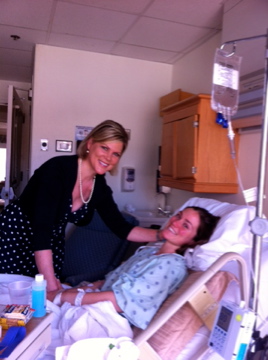
| Jess & me |
This summer, our daughter Jess recovered from a paralyzing nerve disorder within 3 months, less than half the minimum time her doctors insisted it would take. We (she and our family) resolved in the earliest days we would be active participants in the care process.
Here, Jess writes (originally on her blog) hoping her words reach people looking for miracles.
HOW TO ACHIEVE MIRACULOUS RESULTS
IMAGINE that you go to sleep tonight perfectly healthy, and a few days from now you wake up too weak to walk. The doctor explains that the problem is your immune system – it got confused and is attacking the myelin sheath that coats your nerves. She says that the paralysis is going to get worse before it gets better, and that it’s going to take you 6 months to a year to recover.
This is what my neurologist said at the start of the summer when she diagnosed me with a rare
auto-immune disorder called Guillain-Barre syndrome (GBS). When I refused to believe it would take 6 months to recover, she insisted I should keep my expectations “realistic.”
3 months later, I’m going for daily 4-mile hikes and occasionally spicing it up with a 20-mile bike ride to the ocean and back.
When a local TV news reporter asked if my recovery was a “miracle”, a few things went through my head. First was: This reporter clearly just wants an uplifting soundbite to stick onto the end of a predominantly fear-mongering story. Second was: really, local news? I don’t know why I expected more from you.
I tried to skirt her terrible question and offer something real, but in the end she lopped it all off except the skirt itself, which was: “miracles exist but you have to believe in them.” In doing so, she fumbled an opportunity to educate others about what they can actually do to improve their outcomes.
So, as much for my own closure as to add something empowering to the ocean of lament that exists on the Internet, here is a list of 10 practices that played a key role in my “miraculous” recovery. While they are written from a medical perspective, they can be applied to a broad range of situations with a little imagination.
To be fair, I had a few “positive prognostic factors” going for me as an otherwise healthy young athlete who received the correct diagnosis inside the critical window. My mother is also one of the most passionate patient-engagement professionals out there, so I knew I had a critical role to play. Combined with a strong dreamer mentality, I was uniquely positioned to have an amazing outcome – and you can be, too.
Here we go:
10 PRACTICES TO HELP YOU ACHIEVE MIRACULOUS RESULTS
Just imagine being a doctor for a second – you’re talking to two different patients about their respective conditions: one who regards you blankly and says, “whatever you say, doc” and another who looks you directly in the eye and asks you a series of intelligent questions that you don’t really have the answers to. Which patient makes you want to bring your A-game?
When you are hungry for understanding, you inspire the same hunger in others.
2. Embrace uncertainty. Despite all your questions, you may receive zero satisfying answers. Especially with something as rare as GBS, the fact is that no one really knows anything with certainty. So rather than freak yourself out about not having the answers you want, choose to see the enormous question mark as an opportunity to create your own outcome. If they don’t know, why couldn’t it be this?
3. Set an intention and announce it to everyone. I told anyone who would listen that my intention was to recover faster than they said I would, even though some people (like my neurologist) probably thought I was setting myself up for failure and disillusionment. The secret is to also tell yourself these things, every morning when you wake up and throughout the day whenever you feel sleepy : “I am rapidly regenerating my myelin sheath. I am building strength in my hips, glutes, quads and ankles. I am recovering faster than anyone expected.” The goal is to surpass your conscious (critical) brain and get your subconscious brain to start scanning your environment for different types of evidence.
4. Conjure your Golden Cocoon. The Golden Cocoon is a meditation concept that my father introduced me to while I was in the hospital. He regularly instructed me to close my eyes to the antiseptic environment and the pain and envision myself bathed in golden, healing energy. When you envision your resting state this way, it becomes much easier to recognize when certain people or activities are in fact draining that energy. (As the critical nature of my situation lessened, this turned into a joke of sorts, as in: “you’re intruding on my Golden Cocoon.”)
5. Invest in a Nutri-bullet. (Or something just like it.) This single invention (and the fruits and veggies it turns into fiber-rich smoothies) is the reason I didn’t have to take the four different laxatives prescribed to manage the unfortunate side effects of opiate pain meds. Even if you’re healthy and regular, this is one of the best things you can do for your nutrition and energy level. If you have a juicer, ditch it – without the fiber, all you’re getting is a sugar rush.
6. Ask for help! This is not something that comes easily for most, but it helps when you have no choice (thanks, Universe). I was super lucky to have the family that I have, and they all deserve gold stars. But they didn’t do it alone either – they asked for help too, and this made an enormous difference. Just one example: We asked the neurologist about nutrition – she had no idea, and she didn’t seem to think it was all that worth investigating. And if my mom hadn’t reached out to everyone in her network, we never would have learned that myelin is made of “the good kind of fat” and we never would have loaded my diet with avocados, nuts, olive oil, and steak. We also wouldn’t have thought to supplement my medical regimen with Anatabloc (a minty anti-inflammatory derived from the tobacco plant) and liquid vitamin B-12.
7. Commit to being present. This is arguably the most important decision you can make, and you might say it’s the hardest one – because we live in a world of infinite opportunity, it is super easy to be consumed by FOMO (fear of missing out) on all the things you can’t do. Instead, decide that you are here for a reason and you might as well really be here so you can learn whatever it is you’re supposed to learn from it all. Plus, there’s plenty of time now to read all those books (knit all those sweaters/write all that code/watch all those movies) you never have time to read (knit/write/watch), and when you’re better (which you will be) you’ll be wishing you’d taken advantage.
But more importantly, when you are fully present, you notice all the little details that constitute healing and magic. You will notice when your left arm’s range of motion goes from this much to THIS much, and you’ll be able to thread all those small details into a larger feeling of progress. By staying present, my progress snowballed so quickly that by the time I held my hiking poles in my hands for the first time on the 4th of July and realized how close normalcy really was, it was almost more disorienting to let go of my new reality (“unable to walk”) than it had been to accept that I was paralyzed in the first place.
Take a second to think about that: I had accepted my situation so fully that I almost didn’t want to let it go. That’s commitment, which is something we’re all secretly terrified of. But let me tell you – it can be wildly liberating.
8. Don’t commit to the wrong person. My first physical therapist was assigned to me through the Visiting Nurses Association, and I wouldn’t call her awful, exactly. Something was just off - she didn’t make me feel safe (physically or emotionally) and I never felt excited that it was time for physical therapy. In fact, by the third session I had come to dread it, and even though I knew nothing about what physical therapy should be, I knew that dread was not an emotion that had any place in my recovery. So (even though it was inconvenient and rude) we gently gave her the boot.
Then we did another round of asking, which led us to Josh. By himself, Josh could be credited with up to 40 percent of the miracle. Josh just got it – he made me feel safe, supported, hopeful, strong, and authentic. And what’s more, he made me laugh! He never gave me any lists of repetitive exercises to do while he was gone, and every time he arrived he would ask questions about how I was doing and how I felt about what we did last time. He was constantly looking for ways to push me, and he was always celebrating my tiny victories. In fact, nearly every time I saw him (3x a week for 6 weeks), he was saying “wow!” in some way or another, and you could tell he really meant it.
Don’t ignore your gut. It’s all too easy to allow your momentum to continue carrying you forward with the wrong person. If you do, you will be stuck doing band exercises (or the equivalent) for an eternity.
9. Do a cost-benefit analysis. Four weeks into recovery, I noticed that I started feeling disconnected and strange. Googling my medications revealed that one of them is a seizure medication used off-label to treat nerve pain (which only works in 1/3 of patients) that has been associated with increased depressive or suicidal thoughts. I asked my neurologist if we could cut back on it (she had me on 1800 mg a day!) and she said we would have to double the other one. I asked if there was anything else we could try, and she said no. Then she reminded me (forebodingly) that the nerve pain (manifesting as a burning sensation in my hands and feet) was the type that, “once it gets ahead of you it can be very difficult to catch up.” So that night I took twice the amitriptyline, only to wake up the next morning feeling awful and incapable of having any thoughts.
I decided then that I would rather experience moderate physical pain in the mornings and evenings (which, by the way, signals that your nerves are regenerating) than feel like a mindless robot all day. With my primary care doctor’s approval, I cut both doses in half, without any notable change in pain level. A few weeks later, with my parents shrugging their uncertain approval, I stopped taking my meds all together (even though I had a lot left) on the grounds that “it felt like it would be ok.”
And it was! Nobody knows your body and your mind better than you do. These days, doctors see a hint of pain and want to get rid of it right away by flooding your body with artificial chemicals that may or may not have the intended effects. Don’t just mindlessly accept whatever they recommend – it’s up to you to decide if the tradeoff is worth it.
10. Love (your) life and (your) people. This experience can be a profoundly humbling reminder of how much there is to be grateful for and how much community matters, if you choose to see it that way. I spent a lot of time reflecting on how fortunate I am to have such an incredible circle of family and friends. Many of them made time in their schedules to drive or fly out to Rhode Island just to spend hours sitting on the patio with me. I also had a few inspiring interactions with strangers and near-strangers who reminded me that “community” can be a lot bigger than we think.
The best thing you can do for your health and your life is to dwell in a place of positivity and gratitude. Your body is a factory, and your emotions produce chemicals in your body that either promote or inhibit healing. FACT: Love heals. It’s science. So try to produce as much of that as possible – as much for yourself as for everyone else.
So that’s it. My sincerest thanks to everyone who offered their support this summer – I simply couldn’t have done it without you. I’m lucky to be closing this chapter now, but if you or someone you love wants more information, know that I’m part of your community and I’m always happy to help.

.jpg)
.jpg)
.JPG)